 Stadiongatan 65, 217 62 Malmö
 0737369660
 info@iraconsulting.se


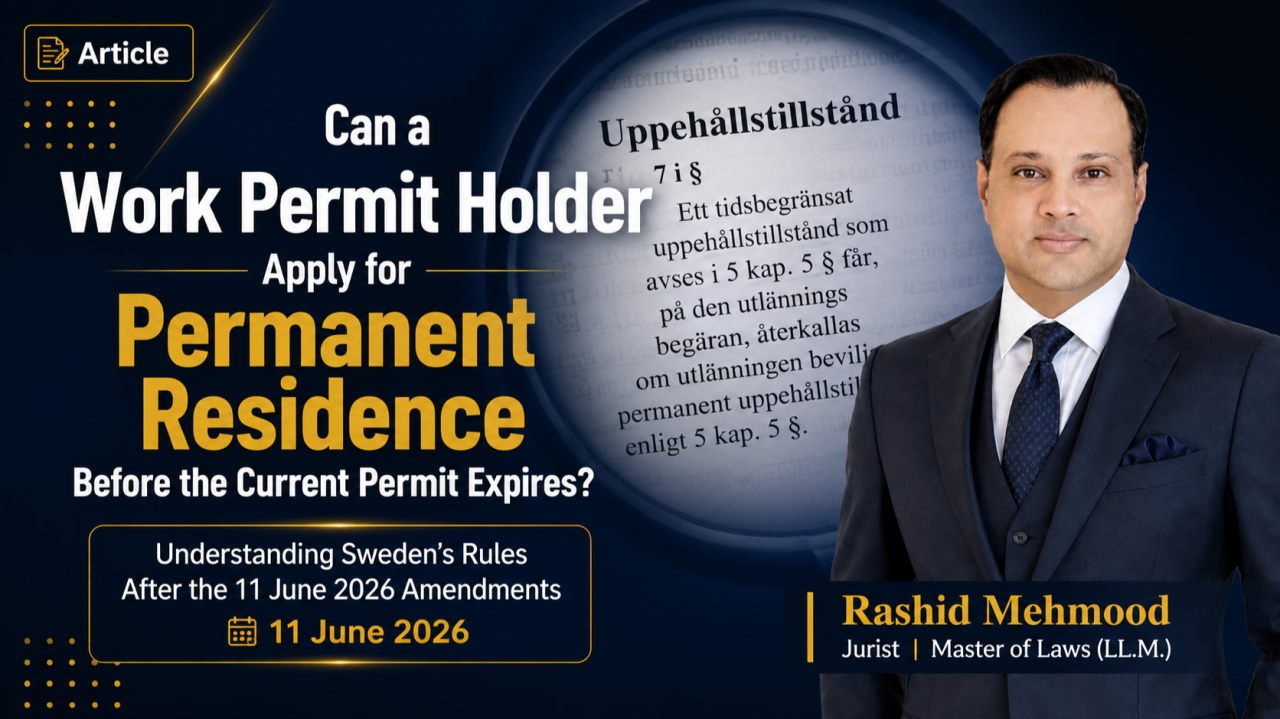

Can a Work Permit Holder Apply for Permanent Residence Before the Current Permit Expires? Understanding Sweden’s Rules After 11 June 2026 amendment
A question that many work permit holders are now asking is the following:
If I have already completed four years with a Swedish work permit, do I have to wait until my current permit is about to expire before I can apply for permanent residence?
The answer requires an understanding of both the 2026 legislative amendments and the Swedish Migration Agency’s current application procedure.
This article explains what changed, what remained the same and how an ordinary work permit holder should currently apply for permanent residence.
The previous rules
Before 11 June 2026, permanent residence was generally considered in connection with an application to extend a temporary residence permit. For ordinary work permit holders, this usually meant that permanent residence was requested when the existing work permit was approaching expiry.
The Government recognised that this could delay permanent residence even where the applicant had already fulfilled all statutory requirements.
Proposition 2025/26:146 explains the following:
“En ansökan om permanent uppehållstillstånd behöver därför i regel ske i anslutning till att ett tidsbegränsat uppehållstillstånd löper ut, även om utlänningen skulle uppfylla förutsättningarna för att beviljas ett permanent uppehållstillstånd tidigare än så.”
In other words, an applicant who already met the legal requirements for permanent residence generally had to wait until the temporary permit was nearing its expiry before permanent residence could be granted.
Why was the law changed?
The Government considered that this was unnecessarily restrictive.
In the preparatory works it stated the following:
“Det är därför rimligt att en ansökan om permanent uppehållstillstånd inte i alla fall måste vara beroende av att utlänningens tidsbegränsade uppehållstillstånd är på väg att löpa ut.”
The purpose of the reform was therefore to allow permanent residence to replace an existing temporary permit without always waiting until that permit expired.
The Government Bill
The amendments were introduced through:
Proposition 2025/26:146
Bättre migrationsrättsliga regler för forskare och doktorander samt åtgärder för att motverka missbruk av uppehållstillstånd för studier.
The proposal was adopted by the Riksdag on 29 April 2026 and entered into force on 11 June 2026 through Lag (2026:457).
What changed in the Aliens Act?
The reform introduced Chapter 7, Section 7 i of the Aliens Act.
The provision states that, at the applicant’s request, a qualifying temporary residence permit may be revoked if the person is granted permanent residence under Chapter 5, Section 5.
The Special Commentary explains:
“Paragrafen innebär att en utlänning som uppfyller förutsättningarna i 5 kap. 5 § första eller andra stycket inte behöver vänta tills det befintliga tidsbegränsade tillståndet löper ut innan han eller hon kan beviljas permanent uppehållstillstånd.”
This is the key legal change.
It means that permanent residence may replace an existing temporary permit before that temporary permit expires.
Does this apply only to researchers?
No.
Although the reform primarily concerned researchers and doctoral students, the Government expressly decided that the new mechanism should also apply to:
- residence permits for employment;
- self-employment;
- research;
- doctoral studies;
- Swedish EU Blue Cards;
- ICT permits;
- ICT long-term mobility; and
- seasonal work.
Accordingly, ordinary work permit holders are also covered by the new legal mechanism.
What has not changed?
The substantive requirements for permanent residence remain. An ordinary work permit holder must still satisfy the relevant conditions under Chapter 5, Section 5 of the Aliens Act.
This normally includes:
- qualifying work permits;
- qualifying employment;
- compliance with previous permit conditions;
- financial self-support;
- the applicable conduct (vandel) requirement; and
- any other statutory requirements.
Completing four years alone does not automatically result in permanent residence.
What does the Swedish Migration Agency say?
The Swedish Migration Agency currently states:
“You can apply for a permanent residence permit once you have held a permit for work for at least four years. You apply for an extension of your permit and indicate in the e-service or on the application form that you are applying for a permanent residence permit.”
The Agency further explains:
“If you are granted a permanent residence permit, your temporary residence permit will be revoked. If you are not granted a permanent residence permit, you will keep your temporary residence permit.”
This guidance reflects the new legislative mechanism introduced by Chapter 7, Section 7 i of the Aliens Act.
How should an ordinary work permit holder apply?
According to the Migration Agency’s current published guidance, the procedure is:
- submit an application to extend the current work permit;
- indicate in the e-service or application form that permanent residence is also requested; and
- submit documentation showing that all statutory requirements for permanent residence are met.
If permanent residence is granted, the temporary permit is revoked. If permanent residence is refused, the existing temporary permit remains valid.
When can the application be submitted?
This is where it is important to distinguish between eligibility and procedure. The Migration Agency states that permanent residence may be requested once the applicant has held a work permit for at least four years. At the same time, the request is made through the work permit extension procedure.
The Agency’s general guidance for ordinary employees also states that an application to extend a work permit is normally submitted no earlier than two months before the current permit expires.
Accordingly, the safest legal interpretation is that the following is true:
- a person becomes eligible to request permanent residence after completing the statutory qualifying period; and
- The request is made through the extension application procedure in accordance with the Migration Agency’s current instructions.
Where the Migration Agency provides written instructions permitting an earlier submission in an individual case, the applicant should retain that correspondence and submit it together with the application.
Example
Assume that an employee:
- has held qualifying work permits and worked in Sweden for four years;
- satisfies the maintenance requirement;
- satisfies the conduct requirement;
- has complied with all work permit conditions; and
- has a current work permit that remains valid.
Once the qualifying period has been completed, the applicant may request permanent residence through the work permit extension procedure. If permanent residence is granted, the temporary permit will be revoked and replaced by a permanent residence permit.
If permanent residence is refused, the temporary permit remains valid.
Conclusion
The amendments that entered into force on 11 June 2026 introduced an important procedural change. A qualifying temporary work permit may now be replaced by permanent residence before the temporary permit expires. Importantly, this mechanism applies not only to researchers and doctoral students, but also to ordinary work permit holders covered by Chapter 5, Section 5 of the Aliens Act.
However, the Swedish Migration Agency’s published guidance remains clear that permanent residence is requested through an application to extend the current work permit, rather than through a separate standalone application. Applicants should therefore follow the Migration Agency’s current application procedure while ensuring that all statutory requirements for permanent residence are satisfied.
Legal Sources
- Aliens Act (2005:716) – Chapter 5, Section 5; Chapter 7, Section 7 i.
- Proposition 2025/26:146 – Bättre migrationsrättsliga regler för forskare och doktorander samt åtgärder för att motverka missbruk av uppehållstillstånd för studier.
- Betänkande 2025/26:SfU23.
- Riksdag decision: 29 April 2026.
- Entry into force: 11 June 2026.
- Swedish Migration Agency: Guidance for employees applying to extend a work permit and request permanent residence.
Disclaimer: This article provides general legal information only. It is not legal advice. Every immigration case is different, and the outcome depends on the individual facts, evidence and the law applicable at the time the decision is made.
