 Stadiongatan 65, 217 62 Malmö
 0737369660
 info@iraconsulting.se


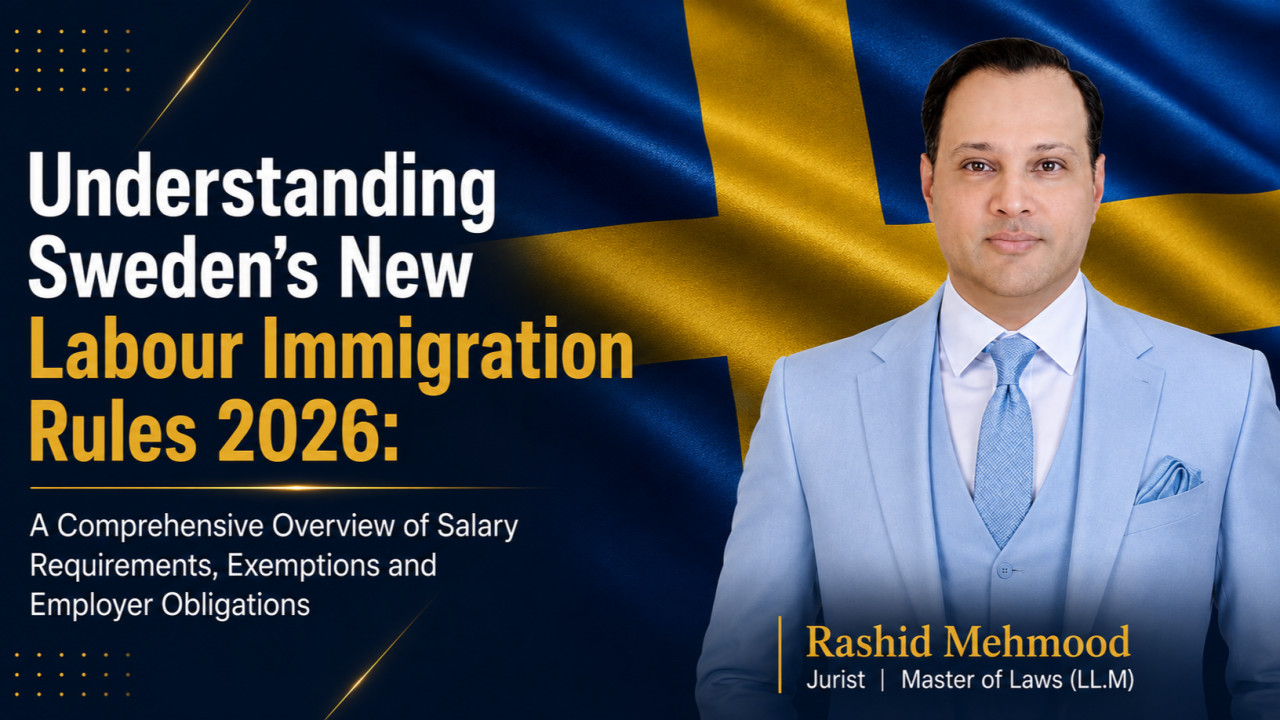

Sweden introduced significant changes to its work permit system from 1 June 2026. The reforms are intended to strengthen labour immigration controls, prevent exploitation of foreign workers, ensure fair wages, and attract highly skilled professionals. The new rules affect both first-time work permit applicants and many individuals applying for permit extensions.
Updated Salary Requirements
One of the most important changes is the increase in the minimum salary requirement. Following Statistics Sweden’s update of the national median salary on 16 June 2026, the current salary thresholds are:
- Standard work permit: SEK 34,470 per month (90% of the median salary).
- Exempt occupations and exempt groups: SEK 28,725 per month (75% of the median salary).
- Transitional extension cases: SEK 30,640 per month (80% of the median salary).
The salary must also be consistent with Swedish collective agreements or what is customary within the relevant profession or industry. If a collective agreement requires a higher salary, the higher salary must be paid.
Transitional Rules for Existing Permit Holders
Workers whose current work permits were granted before 1 June 2026 may benefit from transitional provisions. If an extension application is submitted before 2 December 2026, the previous salary requirement of 80% of the median salary may continue to apply. After the transitional period, most applicants will be subject to the new salary requirements.
Occupations Exempt from the 90% Salary Requirement
The Swedish Government has identified a number of occupations experiencing labour shortages. Individuals working in these occupations may qualify under the reduced salary threshold of 75% of the median salary.
These occupations include:
- Engineers and technicians in chemistry and chemical engineering (SSYK 3115)
- Laboratory engineers (SSYK 3215)
- IT operations technicians (SSYK 3511)
- IT support technicians (SSYK 3512)
- Systems administrators (SSYK 3513)
- Network and systems technicians (SSYK 3514)
- Assistant nurses in home care, home healthcare and elderly care homes (SSYK 5321)
- Assistant nurses in habilitation services (SSYK 5322)
- Assistant nurses in healthcare and specialist wards (SSYK 5323)
- Assistant nurses in outpatient reception services (SSYK 5324)
- Childcare assistants (SSYK 5325)
- Ambulance care assistants (SSYK 5326)
- Care assistants (SSYK 5330)
- Breeders and caretakers of farm animals (SSYK 6121)
- Other animal breeders and animal caretakers (SSYK 6129)
- Crop growers and animal breeders, mixed farming (SSYK 6130)
- Forestry workers (SSYK 6210)
- Welders and gas cutters (SSYK 7212)
- Structural steel erectors and heavy sheet metal workers (SSYK 7215)
- Maintenance mechanics and machine repairers (SSYK 7233)
- Electrical distribution technicians (SSYK 7413)
- Butchers and meat cutters (SSYK 7611)
- Machine operators in meat and fish processing industries (SSYK 8161)
- Other machine operators in the food industry (SSYK 8169)
- Other operations technicians and process monitoring operators (SSYK 8199)
- Drivers of agricultural and forestry machinery (SSYK 8341)
- Berry pickers and planters (SSYK 9210)
The exemption list may be amended by the Government in the future. Applicants should therefore verify that their occupation remains on the exemption list at the time of application.
Additional Exempt Groups
The reduced 75% salary threshold may also apply to:
- International students switching from a student permit to a work permit.
- Researchers and doctoral students.
- Individuals previously protected under the EU Temporary Protection Directive.
- Certain doctors, dentists, nurses and other healthcare professionals seeking Swedish authorisation.
- Employees of qualifying technology and life science start-up companies.
New Insurance Requirements
Employers must provide comprehensive insurance coverage for foreign workers.
Required insurance generally includes:
- Health insurance.
- Life insurance.
- Occupational injury insurance.
- Occupational pension insurance.
The insurance must remain valid throughout the period of employment. Failure to provide adequate insurance may result in refusal of the work permit application.
Stronger Employer Controls
Migrationsverket has been given wider powers to examine employers before approving work permit applications.
Applications may be refused where an employer:
- Has violated labour laws.
- Has serious tax or payroll irregularities.
- Has previously breached immigration regulations.
- Is linked to labour exploitation or abuse.
- Cannot demonstrate a genuine need for the worker.
Some sectors may also be subject to enhanced scrutiny where authorities consider there to be an increased risk of fraud, abuse, or exploitation. Employers must notify Migrationsverket if a worker does not begin employment within four months after the permit becomes valid.
Occupations Excluded from Work Permit Eligibility
From 1 June 2026, ordinary work permits can no longer be granted for:
- Personal assistants (SSYK 5343).
- Forest berry pickers (SSYK 9210).
Workers intending to perform berry-picking work may instead need to apply through the seasonal work permit route where applicable.
Categories Not Subject to the Ordinary Salary Rule
The ordinary 90% salary requirement does not apply in the same way to certain permit categories, including:
- EU and EEA citizens and their family members.
- EU Blue Card holders.
- ICT permit holders.
- Seasonal workers.
- Athletes and coaches.
- Au pairs.
- Trainees and interns under international exchange programmes.
- Trainees in higher education programmes.
- Researchers.
- Individuals covered by international agreements.
These categories are governed by separate legal provisions and requirements.
Changes for Seasonal Workers
Seasonal workers benefit from several changes under the new legislation. The maximum validity period for a seasonal work permit has increased from six months to nine months within a twelve-month period. Seasonal workers must also receive salaries and employment conditions that meet Swedish collective agreements or industry standards.
Changes for ICT Permit Holders
Employees transferred to Sweden through multinational companies under the ICT permit system must receive salaries and employment conditions that correspond to Swedish labour market standards and collective agreements.
EU Blue Card Improvements
The EU Blue Card remains an important route for highly qualified professionals. While the salary threshold for the EU Blue Card remains separate from the ordinary work permit system, permit holders may now receive permits valid for up to four years instead of two years. This provides greater stability and flexibility for skilled workers and their families.
New Opportunities for Researchers and Doctoral Students
Researchers and doctoral students benefit from several improvements. Doctoral students with approved hosting agreements may apply for residence permits for research. Researchers and doctoral students who complete their studies in Sweden may receive permits to seek employment or establish a business for up to eighteen months. Researchers, doctoral students and EU Blue Card holders may also qualify for permanent residence after three years of lawful residence, provided all other permanent residence requirements are satisfied.
Practical Advice for Applicants
Before submitting a work permit application, applicants should ensure that:
- Their salary meets the applicable threshold.
- Their occupation is eligible for a work permit.
- Their employer provides the required insurance coverage.
- Their employment conditions comply with Swedish standards.
- Their employer has a good compliance record.
- All supporting documentation is complete and accurate.
Conclusion
The 2026 reforms represent one of the most significant changes to Sweden’s labour immigration system in recent years. The rules place greater emphasis on fair salaries, proper insurance coverage, employer compliance, and protection against labour exploitation. For most applicants, the key figure is the current minimum salary requirement of SEK 34,470 per month. Exempt occupations and exempt groups generally require a minimum salary of SEK 28,725 per month, while certain extension applicants may continue to benefit from the transitional threshold of SEK 30,640 per month.
Although the rules are stricter than before, they also provide stronger protection for workers and improved opportunities for highly skilled professionals, researchers, healthcare workers, and individuals employed in shortage occupations.
Disclaimer: This article provides general legal information only. It is not legal advice. Every immigration case is different, and the outcome depends on the individual facts, evidence and the law applicable at the time the decision is made.
